Our AOX concept for 2026 represents a full arch with direct fit to multi-unit implants (all-types) using photogrammetry techniques that are proving to be a well priced solution constructed by a structured uncomplicated procedure.
We are nor introducing Cone Beam association to pinpointing the correct geometry for that patient, geometrically. Similar to Pantographing which no one is interested in these days, far too much time involved and it required strick patient adherence to the de-programming procedure. So bu introducing CONE-BEAM CT which began in late in 2023, we are now pioneering a far simpler approach which involves our fully functional articulator I have be using for thirty years. Does it work, yes as chipping and fractures are greatly if not completely eliminated along with several other problems that are distructive in occlusion-functional mandibular motion.
The price of this solution is $1400.00 for 2026 and includes one set of PMMA temporaries and optimized occlusion.
Also included is a resin check system for the photogrammetry STL file and the layering of high fusing ceramic that provides a very high quality and hygienic solution. The check models, one or both when the case is completed is retained by us to recover the Analog fittings unless you prefer to keep the models, we will charge for the model analogues at cost, "Dess.
This page provides all the information about our 2026 AOX solutions.
WHAT WE NEED
AOX CONSTRUCTIONS INVOLVE A LOT MORE DIGITAL REQUIREMENT THAN CLASSIC RESTORATIONS
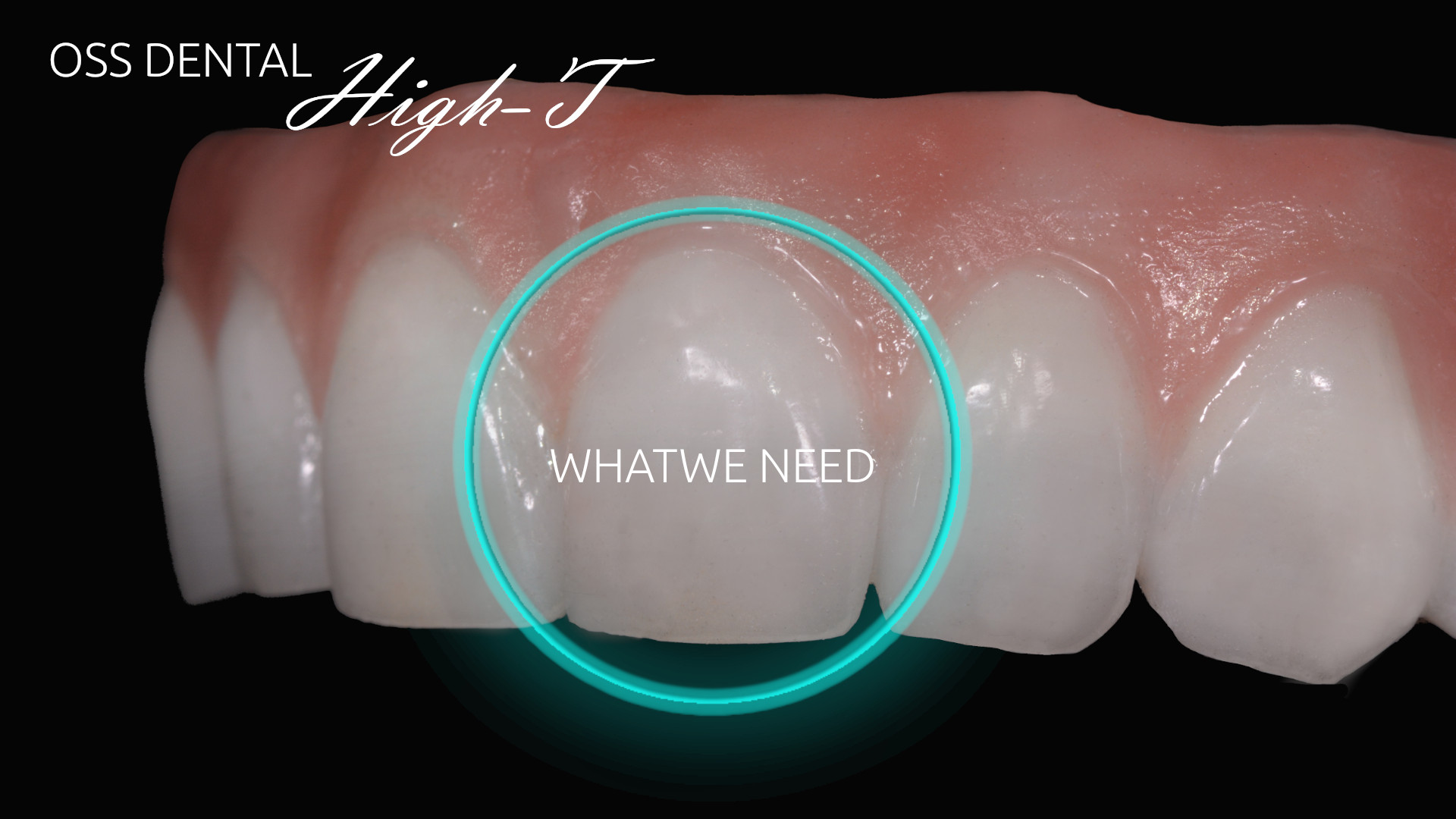
We require a Photogrammetry Scan - A Tissue Scan - A Bite Scan - A completely filled out MX and signed.
We also require an image of the patient so we can design the case to suit the patents features, check and align the horizontal and to assess lip position. Without an image we have no idea of what tooth form to choose or how to setup other critical aspects related to the design or the alternative is we simple make a guess.
PLEASE NOTE: If you are taking case impressions then we will charge $350 for our model and Validation package as additional work will be required to validate the fit with the temporaries before we mill the Zirconia framework. Without the impression validation of fit with a check xray we cannot proceed or we will charge for the remake if that is the only solution.
_____________________________________________________________________________________________________________
WHAT IS INCLUDED IN OUR AOX PRICING AT $1400.00
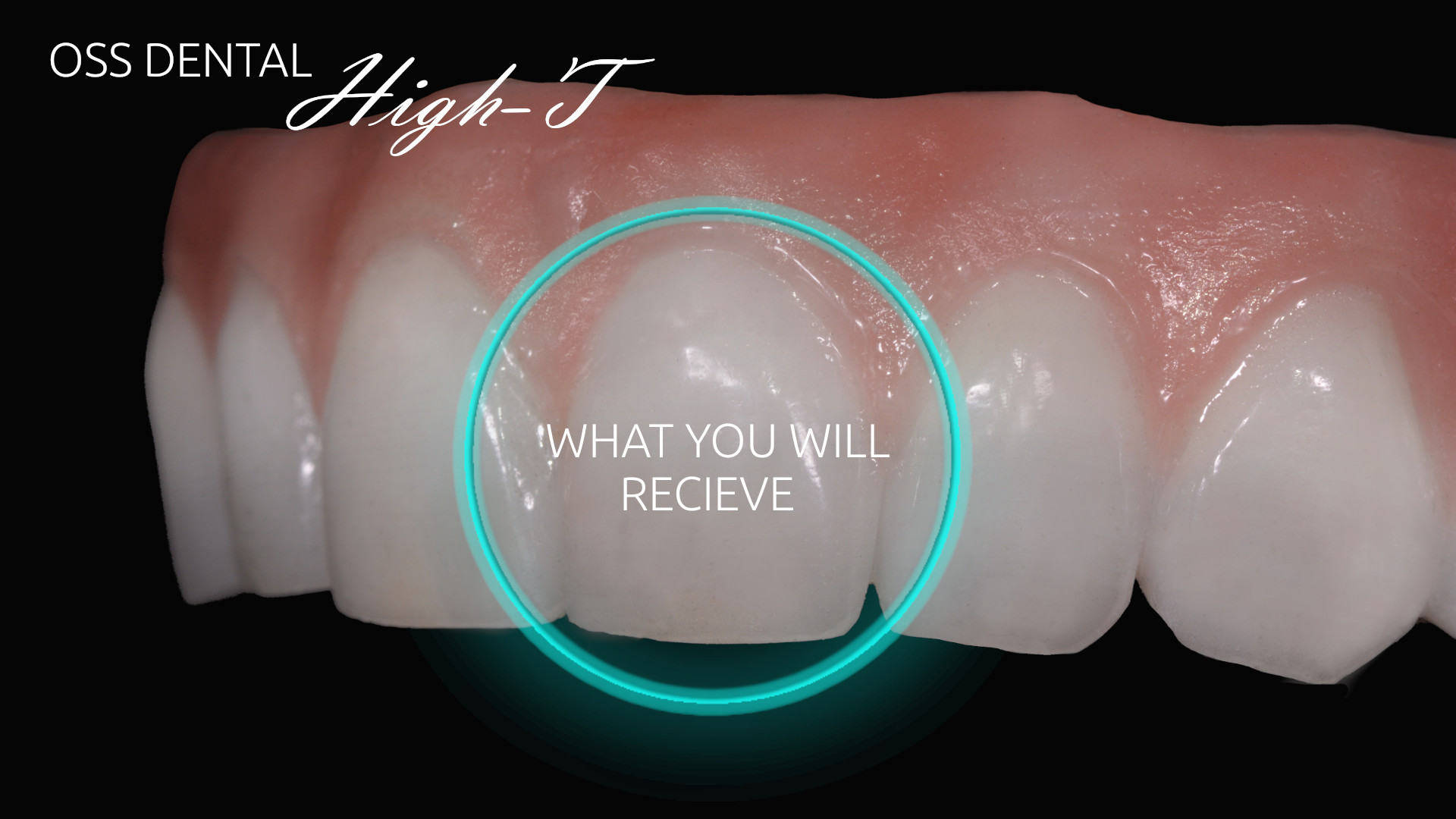
An EXOCAD Design
One set of milled PMMA Temporaries to check the bite and aesthetics.
The milled Zr Monolithic framework (US made puck).
Layered high fusing ceramic for the aesthetics.
A Composite check model to Validate the photogrammetry scan at the laboratory.
A resin opposing bite model/s.
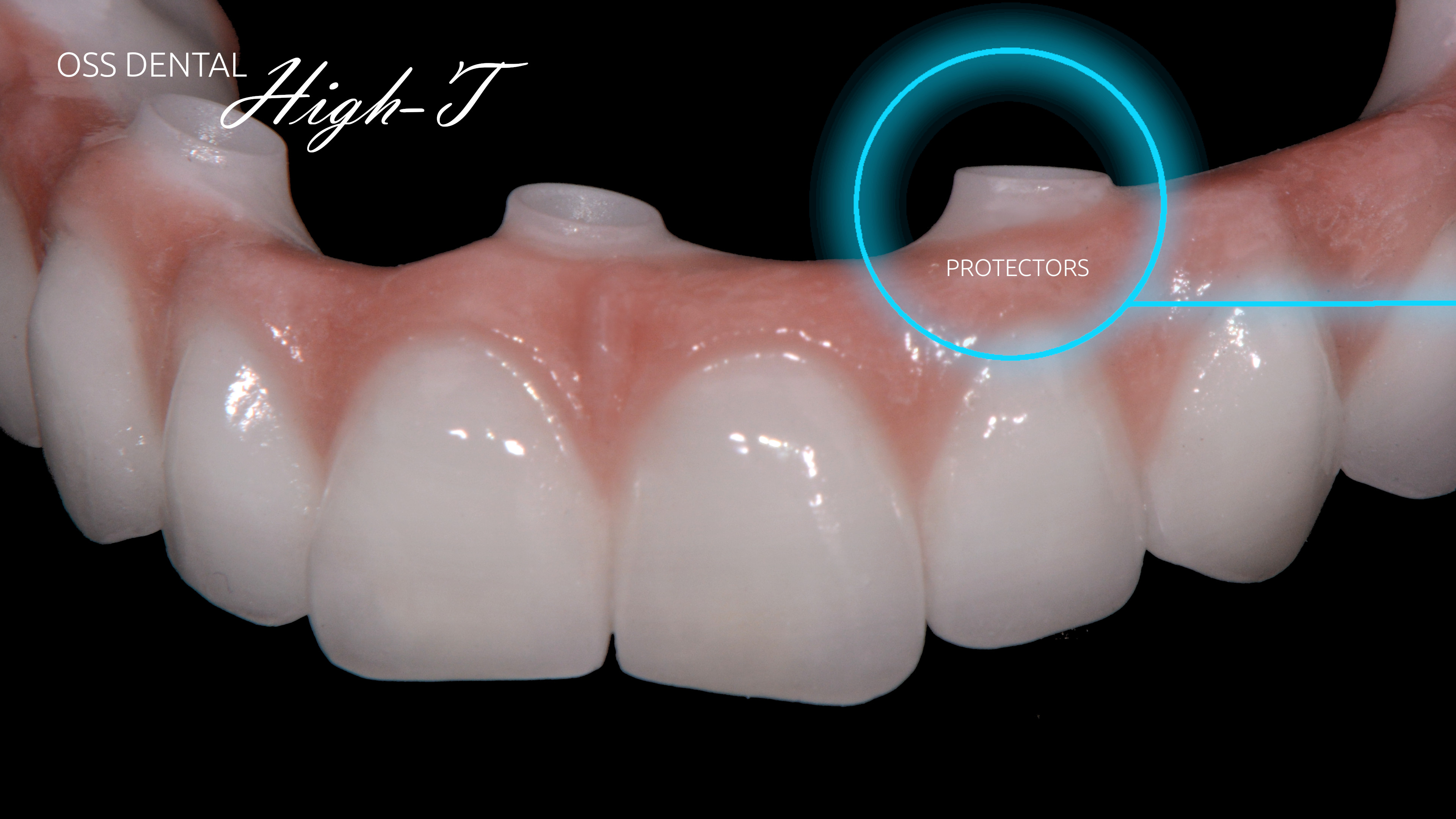
Final polishing is completed with our own Titanium implant fit protectors, selected texturing and hand polishing to finalize zirconia for direct clinical hygiene.
HOW DOES OUR IN-HOUSE CHECK MODEL WORK;
When we receive a Photogrammetry STL file we scan it in with our Medit series 7 scanner and print out a model that represents the STL file. When the Zirconia design is milled we check to see it fits the resin model exactly. If it does we are 95% sure the Substructure will fit. Screws are micrometer checked and fitted for alignment. So far not one arch has failed to fit the resin model or in situ in the mouth. If it does not fit the resin model we check that it is not a milling error first. It it does not fit in Situ we will require a new Photogrammetry STL file.
WHAT IS NOT INCLUDED
TRAY BASED IMPRESSIONS FOR IMPLANT AOX CONSTRUCTIONS WILL REQUIRE VALIDATION OF FIT.- IF IMPRESSIONS ARE SENT ADD $350 FOR THE MODELS AND VALIDATION PACKAGE AS THAT IS NOT INCLUDED
TITANIUM BARS ARE NOT INCLUDED: these can be added on request and billed at cost to the Invoice. Around $700.00 related to design, bonding and finishing. But bars pose issues also in that than can weaken an AOX, not strengthen it.
TI-BASES ARE NOT INCLUDED: Dess or Branded components can be requested and will be added to the final invoice.
TRILOR BARS RE NOT INCLUDED: These are a different construction that requires separate or bridge elements. Single units are the most common approach and can enhance a AOX considerable. Subject to estimates.
Experience has taught us that tray based silicon impression techniques for AOX constructions appear to be far to open to error as the protocol is not a precise science but often based on eyeballed opinions especially when undertaken by lack of understanding and experience.
We focus mainly on dentist working with Photogrammetry for its accuracy, ease of use and reliability as remakes of stages is time consuming and expensive. We require that impression based techniques need to be validated by pickup protocols to reduce the time and money that is lost in redoing techniques as patients can loose confidence as well.
If you are sending us impression based implant casework you will be charged for our model Package - $350.00 which includes the models, articulation and the additional time in milling validation jigs for us to be sure that the case is technically correct.
section>
_____________________________________________________________________________________________________________
HOW DOES HIGH-T WORK - TRANSLUCENCY AND LUMINOSITY - WHATS NEW
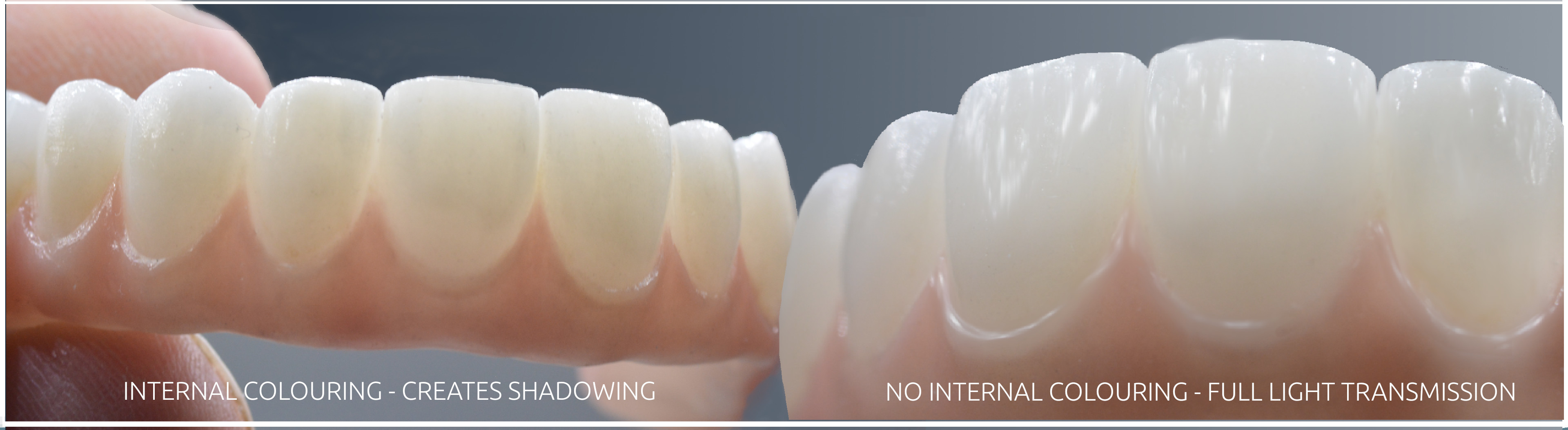
The image above show two arches made with the same powder but with different techniques. Two test samples to indicate the issues related to internal shadowing as metallic oxides are used to color dental ceramic materials. After the fourth firing I stopped working as these samples as show the effects I was pursuing. On the left you can see shadowing withing the ceramic. Metallic oxides are not transparent, none are, they are one hundred percent opaque. The made from metals. What faces you is a particle that reflects its color. The flip side it is casting its shadow. That is not transparent lost. Light does not past through the particles. By mixing them with transparent ceramic powders, clear the mass-intensity ration disperses them. But a footprint within the ceramic matrix exists. By showing typical layering you can see streaks, very faint but quantity leaves shadowing. That foot print is always left and this lowers the value of the chosen color and the translucency.
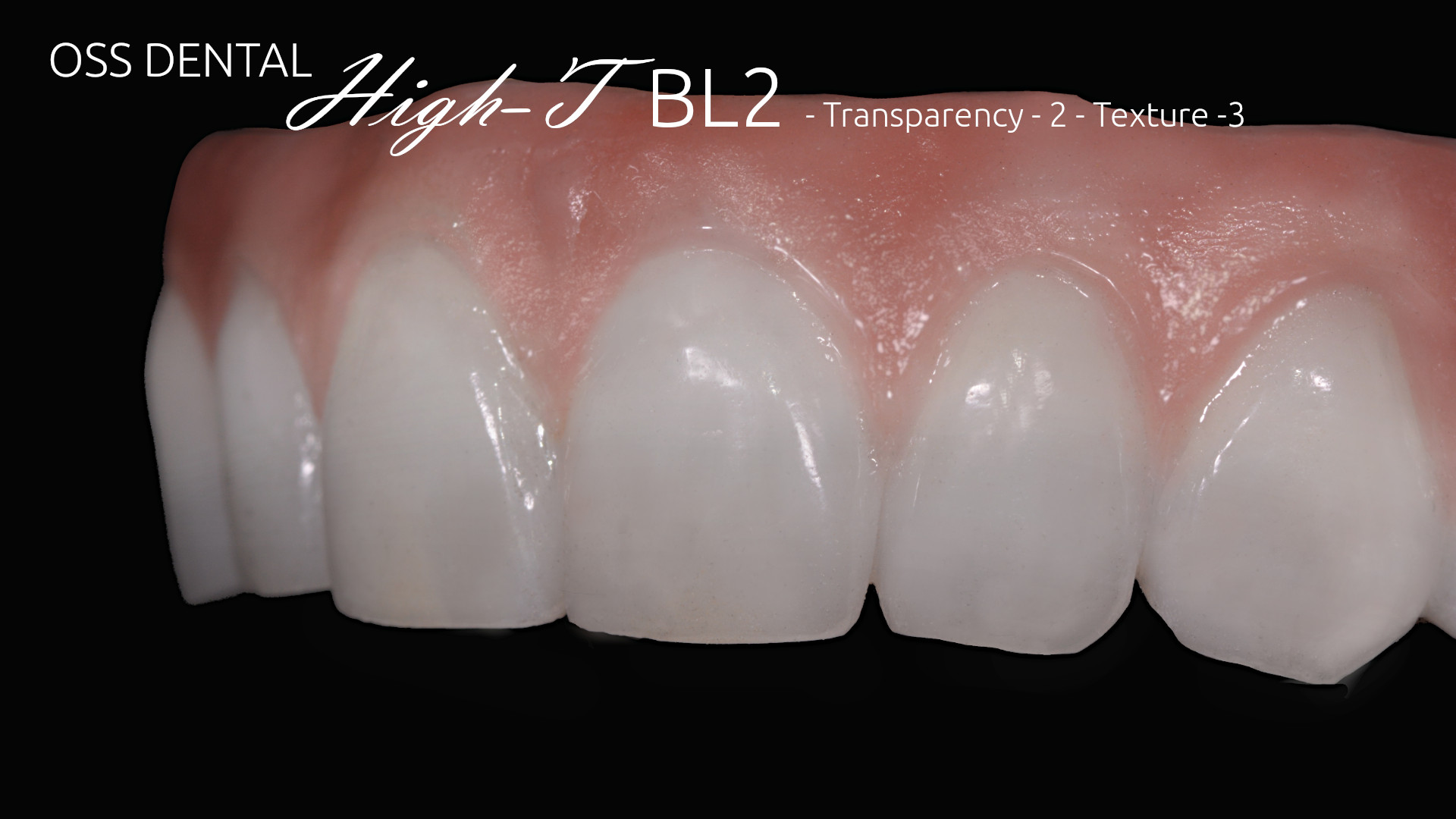
Standard Vita Bleach shades BL1, BL2, BL3, BL4 and A1 to D4 are the standard based shades that basically all dental restorations have conformed to for many years. That means opaque materials are used first which defines the term adaptive ceramic techniques. We no longer do that, we are now using subtractive techniques meaning translucency is priority in how much light can pass through a restoration at any given point with luminosity being how much brightness can be developed from the entire construction. This then increases controlled overall light generation.
As Bleach shades are configured basically mainly from white oxide pigmentation with a basic whitish enamel for the incisal gives little contrast difference, subtractive techniques now pave a new dimension in how opacity can be reduced to match natural light transmission as found in natural dentition. The optical appearance of white then can be controlled far easier as the hybrid interpretation of a bleach shade as a modern tooth concept that is popular in America which often looks opaque in most lighting conditions is improved.
In 2025 and now back in America we decided to reconfigure Bleach shades to provide a better range of options related to how one can choose bleach shade appearance by focussing on brightness and luminosity and not just base opacity. We also focussed on how the structure of an AOX could be better developed and finished as this implant direction of technology is far more complex than standard restorative techniques. This page gives an overall understanding of what we have developed and now offering.
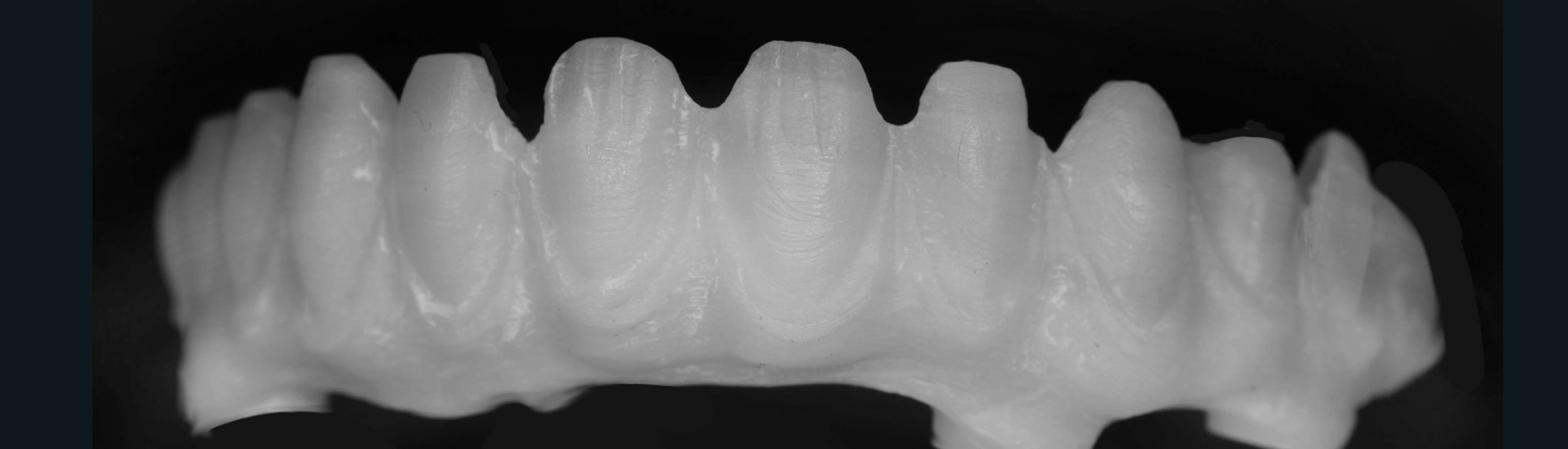
LIGHT TRANSMISSION - HOW TO GAIN CONTROL
HIGH-T construction is now based on my knowledge and background from past involvement and developments in manufacturing high fusing dental ceramics systems and years of restorative ceramic casework based on metallic oxides and no using increased Rayleigh light scattering principles to induce particles much smaller than its wavelength. Shorter wavelengths (blue) scatter much more than longer wavelengths (red). Light science has always driven dental ceramic directions since the mid sixties. Today dental ceramics is very advanced especially in our casework direction is founded on Zirconia as the base to create a mass of scattered light to build on using to increase luminosity with reduce metallic inclusions. light scattering can now pay dividends in what we can offer.
I no longer use multi-layered or color based disks/pucks as they restrict light penetration and cause inconsistency in light disposal across layered graduations. First understand the market you are dealing with. Rapid manufacturing or precision dental ceramics. Two very different markets these days and my preference is precision ceramics with strength and maximum light scattering with less oxide pigmentation. The less metallic oxide used is providing better light transmission. no inclusion is even better, so my direction now is colorless disks and my ceramic work is all made form clear no standard shade powders are being used. Light scattering can provide the white based pigmentation and therefore 50% of oxide pigmentation can be used with no loss of shade ability. This is not ideal for the regular dental laboratories as this involves dedicated time with quite a long learning curve. Techniques for young looking restorations and Bleached shades. All pigmentation metal oxides cast shadows so we have learned a lot in how to use them. We now sinter all our zirconia to eliminate its internal light restrictions to achieve 80% clarity as zirconia is not transparent as a material. its translucent. We also work to eliminate Titanium bars when not required to reduce product pricing and to allow more light transmission and linear strength. We have not had a failure.
The pucks are US made so we have good support in what we are doing to reach 1300 MPa linear grain geometry throughout our monolithic zirconia base parameters. This allows us to achieve far less restrictive light transmission through the entire Zirconia sub-frame. We then coat the first two layers to physically create a boundary layer to stop UV light reaching the zirconia, as UV light is absorbed totally by clear glass and zirconia. So the boundary layer is a defusing layer and remains active in the upper ceramic layering in how we configure the ceramic layers.
This makes for a far brighter case result in direct daylight. So as you might guess we use no stain and glazing techniques. The remaining ceramic layers then can be independent, subtractive and not adaptive by reducing the optical density which we do not want. Creating the final layering by varying there light handling characteristics to our AOX requirements becomes far easier and is closer to light transmission in natural dentition. We have now full control in how UV light affects the luminosity and brightness through pure technique.
FOR A LONG TIME WE LOOKED AT HOW NATURAL DENTITION WORKS
OUR IMPLANT HYGIENE MANAGEMENT
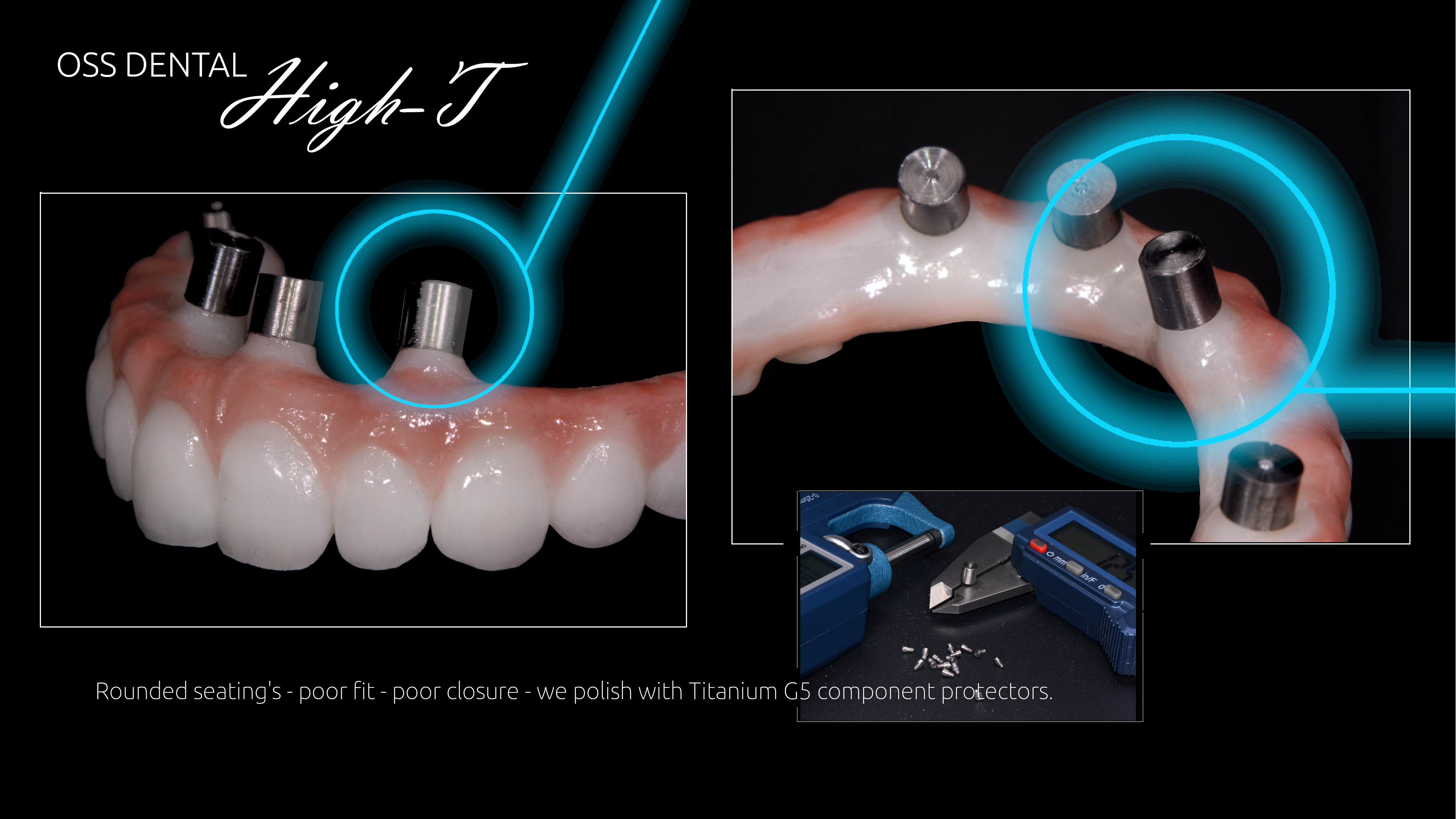
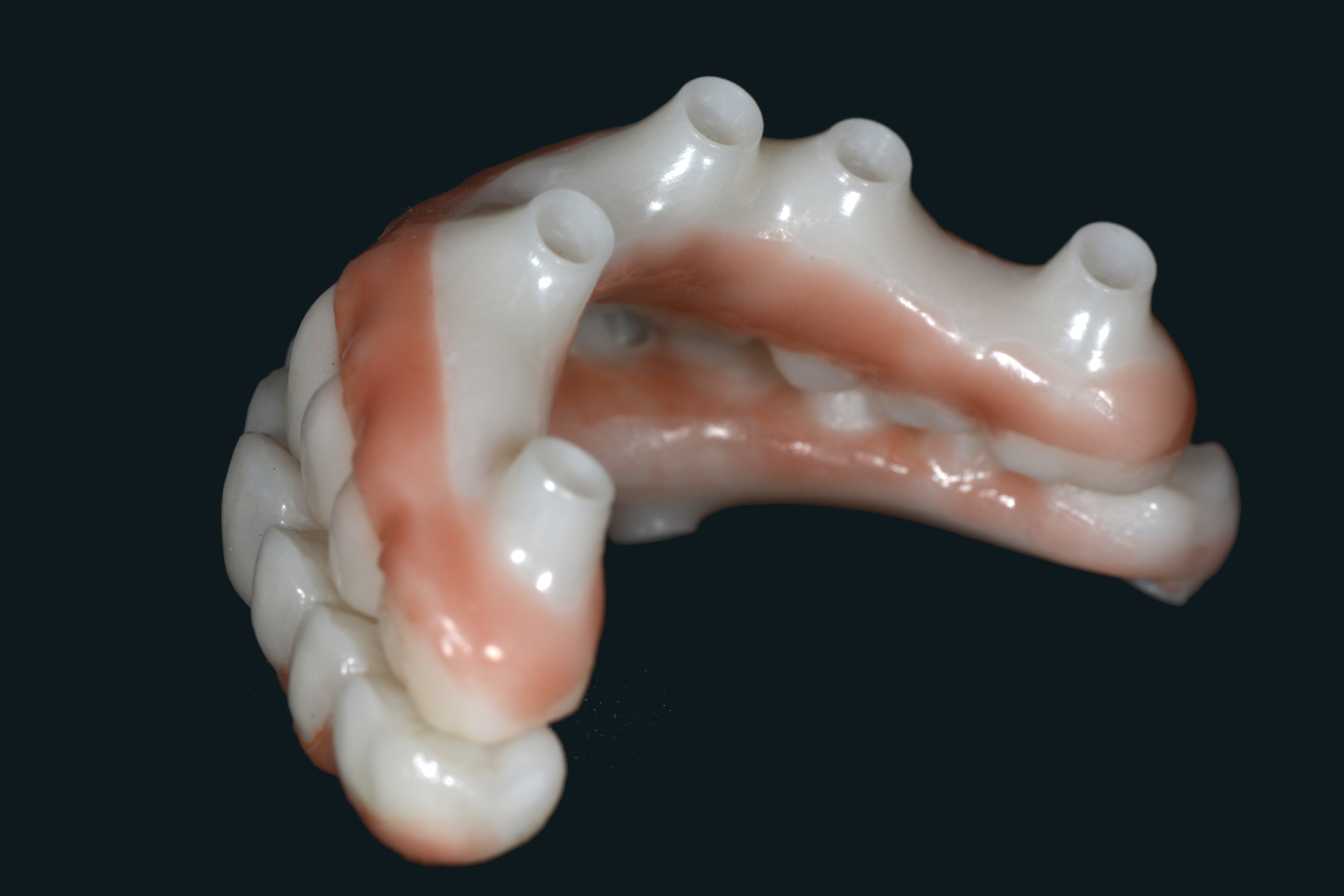
AOX Implants constructions, especially zirconia when used with six or more implants is open to poor hygiene management. Divergent implants are often more difficult to clean so surface finish is critical to reduce plaque adhesion.
To assist in hygiene we focus heavily on implant fit interface accuracy as often the sealing interface of multi-units are narrow and can be easily eroded away or subject to being damaged when finishing an AOX construction.
Cleaning tissue and the implant associated closure contact area must be as accurate as possible. Diamond based agents for polishing are very abrasive and to help this process we developed and produce our own protectors for the zirconia interface from being polished or rounded out. Zirconia is the best material to contact tissue and when polished to a glass finish hygiene that feature can be maximized but the seatings need to be tightly closed and that requires careful handling and protectors to ensure an essential approach to assist in correct finishing.
_____________________________________________________________________________________________________________
We have a lot of top quality images across this website and over 600 images on
FaceBook - https://www.facebook.com/profile.php?id=100009959165185
+1 702 487 0099
Contact:
contact@ossdental.com
All image uploads and STI files over 3mg - Use a image transfer protocol - YOUR OWN or OURS: https://wetransfer.com
All Small files including STL files can be sent to images@ossdental.com
Location:
5730 Skye Pointe Drive
Unit #101
Las Vegas
89130 - NEVADA
USA
Web-Ver. 003 / 01-2025

Copyright OSS DENTAL - All Rights Reserved - 2024
Copyright Website construction and photography - OSS-DENTAL - 2024 All Rights Reserved
The price of this solution is $1400.00 for 2026 and includes one set of PMMA temporaries and optimized occlusion.
Also included is a resin check system for the photogrammetry STL file and the layering of high fusing ceramic that provides a very high quality and hygienic solution. The check models, one or both when the case is completed is retained by us to recover the Analog fittings unless you prefer to keep the models, we will charge for the model analogues at cost, "Dess.
This page provides all the information about our 2026 AOX solutions.
WHAT WE NEED
AOX CONSTRUCTIONS INVOLVE A LOT MORE DIGITAL REQUIREMENT THAN CLASSIC RESTORATIONS
We require a Photogrammetry Scan - A Tissue Scan - A Bite Scan - A completely filled out MX and signed.
We also require an image of the patient so we can design the case to suit the patents features, check and align the horizontal and to assess lip position. Without an image we have no idea of what tooth form to choose or how to setup other critical aspects related to the design or the alternative is we simple make a guess.
PLEASE NOTE: If you are taking case impressions then we will charge $350 for our model and Validation package as additional work will be required to validate the fit with the temporaries before we mill the Zirconia framework. Without the impression validation of fit with a check xray we cannot proceed or we will charge for the remake if that is the only solution.
_____________________________________________________________________________________________________________
WHAT IS INCLUDED IN OUR AOX PRICING AT $1400.00
An EXOCAD Design
One set of milled PMMA Temporaries to check the bite and aesthetics.
The milled Zr Monolithic framework (US made puck).
Layered high fusing ceramic for the aesthetics.
A Composite check model to Validate the photogrammetry scan at the laboratory.
A resin opposing bite model/s.
Final polishing is completed with our own Titanium implant fit protectors, selected texturing and hand polishing to finalize zirconia for direct clinical hygiene.
HOW DOES OUR IN-HOUSE CHECK MODEL WORK;
When we receive a Photogrammetry STL file we scan it in with our Medit series 7 scanner and print out a model that represents the STL file. When the Zirconia design is milled we check to see it fits the resin model exactly. If it does we are 95% sure the Substructure will fit. Screws are micrometer checked and fitted for alignment. So far not one arch has failed to fit the resin model or in situ in the mouth. If it does not fit the resin model we check that it is not a milling error first. It it does not fit in Situ we will require a new Photogrammetry STL file.
WHAT IS NOT INCLUDED
TRAY BASED IMPRESSIONS FOR IMPLANT AOX CONSTRUCTIONS WILL REQUIRE VALIDATION OF FIT.- IF IMPRESSIONS ARE SENT ADD $350 FOR THE MODELS AND VALIDATION PACKAGE AS THAT IS NOT INCLUDED
TITANIUM BARS ARE NOT INCLUDED: these can be added on request and billed at cost to the Invoice. Around $700.00 related to design, bonding and finishing. But bars pose issues also in that than can weaken an AOX, not strengthen it.
TI-BASES ARE NOT INCLUDED: Dess or Branded components can be requested and will be added to the final invoice.
TRILOR BARS RE NOT INCLUDED: These are a different construction that requires separate or bridge elements. Single units are the most common approach and can enhance a AOX considerable. Subject to estimates.
Experience has taught us that tray based silicon impression techniques for AOX constructions appear to be far to open to error as the protocol is not a precise science but often based on eyeballed opinions especially when undertaken by lack of understanding and experience.
We focus mainly on dentist working with Photogrammetry for its accuracy, ease of use and reliability as remakes of stages is time consuming and expensive. We require that impression based techniques need to be validated by pickup protocols to reduce the time and money that is lost in redoing techniques as patients can loose confidence as well.
If you are sending us impression based implant casework you will be charged for our model Package - $350.00 which includes the models, articulation and the additional time in milling validation jigs for us to be sure that the case is technically correct.
section>
_____________________________________________________________________________________________________________
HOW DOES HIGH-T WORK - TRANSLUCENCY AND LUMINOSITY - WHATS NEW
The image above show two arches made with the same powder but with different techniques. Two test samples to indicate the issues related to internal shadowing as metallic oxides are used to color dental ceramic materials. After the fourth firing I stopped working as these samples as show the effects I was pursuing. On the left you can see shadowing withing the ceramic. Metallic oxides are not transparent, none are, they are one hundred percent opaque. The made from metals. What faces you is a particle that reflects its color. The flip side it is casting its shadow. That is not transparent lost. Light does not past through the particles. By mixing them with transparent ceramic powders, clear the mass-intensity ration disperses them. But a footprint within the ceramic matrix exists. By showing typical layering you can see streaks, very faint but quantity leaves shadowing. That foot print is always left and this lowers the value of the chosen color and the translucency.
Standard Vita Bleach shades BL1, BL2, BL3, BL4 and A1 to D4 are the standard based shades that basically all dental restorations have conformed to for many years. That means opaque materials are used first which defines the term adaptive ceramic techniques. We no longer do that, we are now using subtractive techniques meaning translucency is priority in how much light can pass through a restoration at any given point with luminosity being how much brightness can be developed from the entire construction. This then increases controlled overall light generation.
As Bleach shades are configured basically mainly from white oxide pigmentation with a basic whitish enamel for the incisal gives little contrast difference, subtractive techniques now pave a new dimension in how opacity can be reduced to match natural light transmission as found in natural dentition. The optical appearance of white then can be controlled far easier as the hybrid interpretation of a bleach shade as a modern tooth concept that is popular in America which often looks opaque in most lighting conditions is improved.
In 2025 and now back in America we decided to reconfigure Bleach shades to provide a better range of options related to how one can choose bleach shade appearance by focussing on brightness and luminosity and not just base opacity. We also focussed on how the structure of an AOX could be better developed and finished as this implant direction of technology is far more complex than standard restorative techniques. This page gives an overall understanding of what we have developed and now offering.
LIGHT TRANSMISSION - HOW TO GAIN CONTROL
HIGH-T construction is now based on my knowledge and background from past involvement and developments in manufacturing high fusing dental ceramics systems and years of restorative ceramic casework based on metallic oxides and no using increased Rayleigh light scattering principles to induce particles much smaller than its wavelength. Shorter wavelengths (blue) scatter much more than longer wavelengths (red). Light science has always driven dental ceramic directions since the mid sixties. Today dental ceramics is very advanced especially in our casework direction is founded on Zirconia as the base to create a mass of scattered light to build on using to increase luminosity with reduce metallic inclusions. light scattering can now pay dividends in what we can offer.
I no longer use multi-layered or color based disks/pucks as they restrict light penetration and cause inconsistency in light disposal across layered graduations. First understand the market you are dealing with. Rapid manufacturing or precision dental ceramics. Two very different markets these days and my preference is precision ceramics with strength and maximum light scattering with less oxide pigmentation. The less metallic oxide used is providing better light transmission. no inclusion is even better, so my direction now is colorless disks and my ceramic work is all made form clear no standard shade powders are being used. Light scattering can provide the white based pigmentation and therefore 50% of oxide pigmentation can be used with no loss of shade ability. This is not ideal for the regular dental laboratories as this involves dedicated time with quite a long learning curve. Techniques for young looking restorations and Bleached shades. All pigmentation metal oxides cast shadows so we have learned a lot in how to use them. We now sinter all our zirconia to eliminate its internal light restrictions to achieve 80% clarity as zirconia is not transparent as a material. its translucent. We also work to eliminate Titanium bars when not required to reduce product pricing and to allow more light transmission and linear strength. We have not had a failure.
The pucks are US made so we have good support in what we are doing to reach 1300 MPa linear grain geometry throughout our monolithic zirconia base parameters. This allows us to achieve far less restrictive light transmission through the entire Zirconia sub-frame. We then coat the first two layers to physically create a boundary layer to stop UV light reaching the zirconia, as UV light is absorbed totally by clear glass and zirconia. So the boundary layer is a defusing layer and remains active in the upper ceramic layering in how we configure the ceramic layers.
This makes for a far brighter case result in direct daylight. So as you might guess we use no stain and glazing techniques. The remaining ceramic layers then can be independent, subtractive and not adaptive by reducing the optical density which we do not want. Creating the final layering by varying there light handling characteristics to our AOX requirements becomes far easier and is closer to light transmission in natural dentition. We have now full control in how UV light affects the luminosity and brightness through pure technique.
FOR A LONG TIME WE LOOKED AT HOW NATURAL DENTITION WORKS
OUR IMPLANT HYGIENE MANAGEMENT
AOX Implants constructions, especially zirconia when used with six or more implants is open to poor hygiene management. Divergent implants are often more difficult to clean so surface finish is critical to reduce plaque adhesion.
To assist in hygiene we focus heavily on implant fit interface accuracy as often the sealing interface of multi-units are narrow and can be easily eroded away or subject to being damaged when finishing an AOX construction.
Cleaning tissue and the implant associated closure contact area must be as accurate as possible. Diamond based agents for polishing are very abrasive and to help this process we developed and produce our own protectors for the zirconia interface from being polished or rounded out. Zirconia is the best material to contact tissue and when polished to a glass finish hygiene that feature can be maximized but the seatings need to be tightly closed and that requires careful handling and protectors to ensure an essential approach to assist in correct finishing.
_____________________________________________________________________________________________________________
We have a lot of top quality images across this website and over 600 images on
FaceBook - https://www.facebook.com/profile.php?id=100009959165185
+1 702 487 0099
Contact:
contact@ossdental.com
All image uploads and STI files over 3mg - Use a image transfer protocol - YOUR OWN or OURS: https://wetransfer.com
All Small files including STL files can be sent to images@ossdental.com
Location:
5730 Skye Pointe Drive
Unit #101
Las Vegas
89130 - NEVADA
USA
Web-Ver. 003 / 01-2025
Copyright OSS DENTAL - All Rights Reserved - 2024
Copyright Website construction and photography - OSS-DENTAL - 2024 All Rights Reserved
Also included is a resin check system for the photogrammetry STL file and the layering of high fusing ceramic that provides a very high quality and hygienic solution. The check models, one or both when the case is completed is retained by us to recover the Analog fittings unless you prefer to keep the models, we will charge for the model analogues at cost, "Dess.
This page provides all the information about our 2026 AOX solutions.
WHAT WE NEED
AOX CONSTRUCTIONS INVOLVE A LOT MORE DIGITAL REQUIREMENT THAN CLASSIC RESTORATIONS
We require a Photogrammetry Scan - A Tissue Scan - A Bite Scan - A completely filled out MX and signed.
We also require an image of the patient so we can design the case to suit the patents features, check and align the horizontal and to assess lip position. Without an image we have no idea of what tooth form to choose or how to setup other critical aspects related to the design or the alternative is we simple make a guess.
PLEASE NOTE: If you are taking case impressions then we will charge $350 for our model and Validation package as additional work will be required to validate the fit with the temporaries before we mill the Zirconia framework. Without the impression validation of fit with a check xray we cannot proceed or we will charge for the remake if that is the only solution.
_____________________________________________________________________________________________________________
WHAT IS INCLUDED IN OUR AOX PRICING AT $1400.00
An EXOCAD Design
One set of milled PMMA Temporaries to check the bite and aesthetics.
The milled Zr Monolithic framework (US made puck).
Layered high fusing ceramic for the aesthetics.
A Composite check model to Validate the photogrammetry scan at the laboratory.
A resin opposing bite model/s.
Final polishing is completed with our own Titanium implant fit protectors, selected texturing and hand polishing to finalize zirconia for direct clinical hygiene.
HOW DOES OUR IN-HOUSE CHECK MODEL WORK;
When we receive a Photogrammetry STL file we scan it in with our Medit series 7 scanner and print out a model that represents the STL file. When the Zirconia design is milled we check to see it fits the resin model exactly. If it does we are 95% sure the Substructure will fit. Screws are micrometer checked and fitted for alignment. So far not one arch has failed to fit the resin model or in situ in the mouth. If it does not fit the resin model we check that it is not a milling error first. It it does not fit in Situ we will require a new Photogrammetry STL file.
WHAT IS NOT INCLUDED
TRAY BASED IMPRESSIONS FOR IMPLANT AOX CONSTRUCTIONS WILL REQUIRE VALIDATION OF FIT.- IF IMPRESSIONS ARE SENT ADD $350 FOR THE MODELS AND VALIDATION PACKAGE AS THAT IS NOT INCLUDED
TITANIUM BARS ARE NOT INCLUDED: these can be added on request and billed at cost to the Invoice. Around $700.00 related to design, bonding and finishing. But bars pose issues also in that than can weaken an AOX, not strengthen it.
TI-BASES ARE NOT INCLUDED: Dess or Branded components can be requested and will be added to the final invoice.
TRILOR BARS RE NOT INCLUDED: These are a different construction that requires separate or bridge elements. Single units are the most common approach and can enhance a AOX considerable. Subject to estimates.
Experience has taught us that tray based silicon impression techniques for AOX constructions appear to be far to open to error as the protocol is not a precise science but often based on eyeballed opinions especially when undertaken by lack of understanding and experience.
We focus mainly on dentist working with Photogrammetry for its accuracy, ease of use and reliability as remakes of stages is time consuming and expensive. We require that impression based techniques need to be validated by pickup protocols to reduce the time and money that is lost in redoing techniques as patients can loose confidence as well.
If you are sending us impression based implant casework you will be charged for our model Package - $350.00 which includes the models, articulation and the additional time in milling validation jigs for us to be sure that the case is technically correct.
section>
_____________________________________________________________________________________________________________
HOW DOES HIGH-T WORK - TRANSLUCENCY AND LUMINOSITY - WHATS NEW
The image above show two arches made with the same powder but with different techniques. Two test samples to indicate the issues related to internal shadowing as metallic oxides are used to color dental ceramic materials. After the fourth firing I stopped working as these samples as show the effects I was pursuing. On the left you can see shadowing withing the ceramic. Metallic oxides are not transparent, none are, they are one hundred percent opaque. The made from metals. What faces you is a particle that reflects its color. The flip side it is casting its shadow. That is not transparent lost. Light does not past through the particles. By mixing them with transparent ceramic powders, clear the mass-intensity ration disperses them. But a footprint within the ceramic matrix exists. By showing typical layering you can see streaks, very faint but quantity leaves shadowing. That foot print is always left and this lowers the value of the chosen color and the translucency.
Standard Vita Bleach shades BL1, BL2, BL3, BL4 and A1 to D4 are the standard based shades that basically all dental restorations have conformed to for many years. That means opaque materials are used first which defines the term adaptive ceramic techniques. We no longer do that, we are now using subtractive techniques meaning translucency is priority in how much light can pass through a restoration at any given point with luminosity being how much brightness can be developed from the entire construction. This then increases controlled overall light generation.
As Bleach shades are configured basically mainly from white oxide pigmentation with a basic whitish enamel for the incisal gives little contrast difference, subtractive techniques now pave a new dimension in how opacity can be reduced to match natural light transmission as found in natural dentition. The optical appearance of white then can be controlled far easier as the hybrid interpretation of a bleach shade as a modern tooth concept that is popular in America which often looks opaque in most lighting conditions is improved.
In 2025 and now back in America we decided to reconfigure Bleach shades to provide a better range of options related to how one can choose bleach shade appearance by focussing on brightness and luminosity and not just base opacity. We also focussed on how the structure of an AOX could be better developed and finished as this implant direction of technology is far more complex than standard restorative techniques. This page gives an overall understanding of what we have developed and now offering.
LIGHT TRANSMISSION - HOW TO GAIN CONTROL
HIGH-T construction is now based on my knowledge and background from past involvement and developments in manufacturing high fusing dental ceramics systems and years of restorative ceramic casework based on metallic oxides and no using increased Rayleigh light scattering principles to induce particles much smaller than its wavelength. Shorter wavelengths (blue) scatter much more than longer wavelengths (red). Light science has always driven dental ceramic directions since the mid sixties. Today dental ceramics is very advanced especially in our casework direction is founded on Zirconia as the base to create a mass of scattered light to build on using to increase luminosity with reduce metallic inclusions. light scattering can now pay dividends in what we can offer.
I no longer use multi-layered or color based disks/pucks as they restrict light penetration and cause inconsistency in light disposal across layered graduations. First understand the market you are dealing with. Rapid manufacturing or precision dental ceramics. Two very different markets these days and my preference is precision ceramics with strength and maximum light scattering with less oxide pigmentation. The less metallic oxide used is providing better light transmission. no inclusion is even better, so my direction now is colorless disks and my ceramic work is all made form clear no standard shade powders are being used. Light scattering can provide the white based pigmentation and therefore 50% of oxide pigmentation can be used with no loss of shade ability. This is not ideal for the regular dental laboratories as this involves dedicated time with quite a long learning curve. Techniques for young looking restorations and Bleached shades. All pigmentation metal oxides cast shadows so we have learned a lot in how to use them. We now sinter all our zirconia to eliminate its internal light restrictions to achieve 80% clarity as zirconia is not transparent as a material. its translucent. We also work to eliminate Titanium bars when not required to reduce product pricing and to allow more light transmission and linear strength. We have not had a failure.
The pucks are US made so we have good support in what we are doing to reach 1300 MPa linear grain geometry throughout our monolithic zirconia base parameters. This allows us to achieve far less restrictive light transmission through the entire Zirconia sub-frame. We then coat the first two layers to physically create a boundary layer to stop UV light reaching the zirconia, as UV light is absorbed totally by clear glass and zirconia. So the boundary layer is a defusing layer and remains active in the upper ceramic layering in how we configure the ceramic layers.
This makes for a far brighter case result in direct daylight. So as you might guess we use no stain and glazing techniques. The remaining ceramic layers then can be independent, subtractive and not adaptive by reducing the optical density which we do not want. Creating the final layering by varying there light handling characteristics to our AOX requirements becomes far easier and is closer to light transmission in natural dentition. We have now full control in how UV light affects the luminosity and brightness through pure technique.
FOR A LONG TIME WE LOOKED AT HOW NATURAL DENTITION WORKS
OUR IMPLANT HYGIENE MANAGEMENT
AOX Implants constructions, especially zirconia when used with six or more implants is open to poor hygiene management. Divergent implants are often more difficult to clean so surface finish is critical to reduce plaque adhesion.
To assist in hygiene we focus heavily on implant fit interface accuracy as often the sealing interface of multi-units are narrow and can be easily eroded away or subject to being damaged when finishing an AOX construction.
Cleaning tissue and the implant associated closure contact area must be as accurate as possible. Diamond based agents for polishing are very abrasive and to help this process we developed and produce our own protectors for the zirconia interface from being polished or rounded out. Zirconia is the best material to contact tissue and when polished to a glass finish hygiene that feature can be maximized but the seatings need to be tightly closed and that requires careful handling and protectors to ensure an essential approach to assist in correct finishing.
_____________________________________________________________________________________________________________
We have a lot of top quality images across this website and over 600 images on
FaceBook - https://www.facebook.com/profile.php?id=100009959165185
+1 702 487 0099
Contact:
contact@ossdental.com
All image uploads and STI files over 3mg - Use a image transfer protocol - YOUR OWN or OURS: https://wetransfer.com
All Small files including STL files can be sent to images@ossdental.com
Location:
5730 Skye Pointe Drive
Unit #101
Las Vegas
89130 - NEVADA
USA
Web-Ver. 003 / 01-2025
Copyright OSS DENTAL - All Rights Reserved - 2024
Copyright Website construction and photography - OSS-DENTAL - 2024 All Rights Reserved
We also require an image of the patient so we can design the case to suit the patents features, check and align the horizontal and to assess lip position. Without an image we have no idea of what tooth form to choose or how to setup other critical aspects related to the design or the alternative is we simple make a guess.
PLEASE NOTE: If you are taking case impressions then we will charge $350 for our model and Validation package as additional work will be required to validate the fit with the temporaries before we mill the Zirconia framework. Without the impression validation of fit with a check xray we cannot proceed or we will charge for the remake if that is the only solution.
_____________________________________________________________________________________________________________
WHAT IS INCLUDED IN OUR AOX PRICING AT $1400.00
An EXOCAD Design
One set of milled PMMA Temporaries to check the bite and aesthetics.
The milled Zr Monolithic framework (US made puck).
Layered high fusing ceramic for the aesthetics.
A Composite check model to Validate the photogrammetry scan at the laboratory.
A resin opposing bite model/s.
Final polishing is completed with our own Titanium implant fit protectors, selected texturing and hand polishing to finalize zirconia for direct clinical hygiene.
HOW DOES OUR IN-HOUSE CHECK MODEL WORK;
When we receive a Photogrammetry STL file we scan it in with our Medit series 7 scanner and print out a model that represents the STL file. When the Zirconia design is milled we check to see it fits the resin model exactly. If it does we are 95% sure the Substructure will fit. Screws are micrometer checked and fitted for alignment. So far not one arch has failed to fit the resin model or in situ in the mouth. If it does not fit the resin model we check that it is not a milling error first. It it does not fit in Situ we will require a new Photogrammetry STL file.
WHAT IS NOT INCLUDED
TRAY BASED IMPRESSIONS FOR IMPLANT AOX CONSTRUCTIONS WILL REQUIRE VALIDATION OF FIT.- IF IMPRESSIONS ARE SENT ADD $350 FOR THE MODELS AND VALIDATION PACKAGE AS THAT IS NOT INCLUDED
TITANIUM BARS ARE NOT INCLUDED: these can be added on request and billed at cost to the Invoice. Around $700.00 related to design, bonding and finishing. But bars pose issues also in that than can weaken an AOX, not strengthen it.
TI-BASES ARE NOT INCLUDED: Dess or Branded components can be requested and will be added to the final invoice.
TRILOR BARS RE NOT INCLUDED: These are a different construction that requires separate or bridge elements. Single units are the most common approach and can enhance a AOX considerable. Subject to estimates.
Experience has taught us that tray based silicon impression techniques for AOX constructions appear to be far to open to error as the protocol is not a precise science but often based on eyeballed opinions especially when undertaken by lack of understanding and experience.
We focus mainly on dentist working with Photogrammetry for its accuracy, ease of use and reliability as remakes of stages is time consuming and expensive. We require that impression based techniques need to be validated by pickup protocols to reduce the time and money that is lost in redoing techniques as patients can loose confidence as well.
If you are sending us impression based implant casework you will be charged for our model Package - $350.00 which includes the models, articulation and the additional time in milling validation jigs for us to be sure that the case is technically correct.
section>
_____________________________________________________________________________________________________________
HOW DOES HIGH-T WORK - TRANSLUCENCY AND LUMINOSITY - WHATS NEW
The image above show two arches made with the same powder but with different techniques. Two test samples to indicate the issues related to internal shadowing as metallic oxides are used to color dental ceramic materials. After the fourth firing I stopped working as these samples as show the effects I was pursuing. On the left you can see shadowing withing the ceramic. Metallic oxides are not transparent, none are, they are one hundred percent opaque. The made from metals. What faces you is a particle that reflects its color. The flip side it is casting its shadow. That is not transparent lost. Light does not past through the particles. By mixing them with transparent ceramic powders, clear the mass-intensity ration disperses them. But a footprint within the ceramic matrix exists. By showing typical layering you can see streaks, very faint but quantity leaves shadowing. That foot print is always left and this lowers the value of the chosen color and the translucency.
Standard Vita Bleach shades BL1, BL2, BL3, BL4 and A1 to D4 are the standard based shades that basically all dental restorations have conformed to for many years. That means opaque materials are used first which defines the term adaptive ceramic techniques. We no longer do that, we are now using subtractive techniques meaning translucency is priority in how much light can pass through a restoration at any given point with luminosity being how much brightness can be developed from the entire construction. This then increases controlled overall light generation.
As Bleach shades are configured basically mainly from white oxide pigmentation with a basic whitish enamel for the incisal gives little contrast difference, subtractive techniques now pave a new dimension in how opacity can be reduced to match natural light transmission as found in natural dentition. The optical appearance of white then can be controlled far easier as the hybrid interpretation of a bleach shade as a modern tooth concept that is popular in America which often looks opaque in most lighting conditions is improved.
In 2025 and now back in America we decided to reconfigure Bleach shades to provide a better range of options related to how one can choose bleach shade appearance by focussing on brightness and luminosity and not just base opacity. We also focussed on how the structure of an AOX could be better developed and finished as this implant direction of technology is far more complex than standard restorative techniques. This page gives an overall understanding of what we have developed and now offering.
LIGHT TRANSMISSION - HOW TO GAIN CONTROL
HIGH-T construction is now based on my knowledge and background from past involvement and developments in manufacturing high fusing dental ceramics systems and years of restorative ceramic casework based on metallic oxides and no using increased Rayleigh light scattering principles to induce particles much smaller than its wavelength. Shorter wavelengths (blue) scatter much more than longer wavelengths (red). Light science has always driven dental ceramic directions since the mid sixties. Today dental ceramics is very advanced especially in our casework direction is founded on Zirconia as the base to create a mass of scattered light to build on using to increase luminosity with reduce metallic inclusions. light scattering can now pay dividends in what we can offer.
I no longer use multi-layered or color based disks/pucks as they restrict light penetration and cause inconsistency in light disposal across layered graduations. First understand the market you are dealing with. Rapid manufacturing or precision dental ceramics. Two very different markets these days and my preference is precision ceramics with strength and maximum light scattering with less oxide pigmentation. The less metallic oxide used is providing better light transmission. no inclusion is even better, so my direction now is colorless disks and my ceramic work is all made form clear no standard shade powders are being used. Light scattering can provide the white based pigmentation and therefore 50% of oxide pigmentation can be used with no loss of shade ability. This is not ideal for the regular dental laboratories as this involves dedicated time with quite a long learning curve. Techniques for young looking restorations and Bleached shades. All pigmentation metal oxides cast shadows so we have learned a lot in how to use them. We now sinter all our zirconia to eliminate its internal light restrictions to achieve 80% clarity as zirconia is not transparent as a material. its translucent. We also work to eliminate Titanium bars when not required to reduce product pricing and to allow more light transmission and linear strength. We have not had a failure.
The pucks are US made so we have good support in what we are doing to reach 1300 MPa linear grain geometry throughout our monolithic zirconia base parameters. This allows us to achieve far less restrictive light transmission through the entire Zirconia sub-frame. We then coat the first two layers to physically create a boundary layer to stop UV light reaching the zirconia, as UV light is absorbed totally by clear glass and zirconia. So the boundary layer is a defusing layer and remains active in the upper ceramic layering in how we configure the ceramic layers.
This makes for a far brighter case result in direct daylight. So as you might guess we use no stain and glazing techniques. The remaining ceramic layers then can be independent, subtractive and not adaptive by reducing the optical density which we do not want. Creating the final layering by varying there light handling characteristics to our AOX requirements becomes far easier and is closer to light transmission in natural dentition. We have now full control in how UV light affects the luminosity and brightness through pure technique.
FOR A LONG TIME WE LOOKED AT HOW NATURAL DENTITION WORKS
OUR IMPLANT HYGIENE MANAGEMENT
AOX Implants constructions, especially zirconia when used with six or more implants is open to poor hygiene management. Divergent implants are often more difficult to clean so surface finish is critical to reduce plaque adhesion.
To assist in hygiene we focus heavily on implant fit interface accuracy as often the sealing interface of multi-units are narrow and can be easily eroded away or subject to being damaged when finishing an AOX construction.
Cleaning tissue and the implant associated closure contact area must be as accurate as possible. Diamond based agents for polishing are very abrasive and to help this process we developed and produce our own protectors for the zirconia interface from being polished or rounded out. Zirconia is the best material to contact tissue and when polished to a glass finish hygiene that feature can be maximized but the seatings need to be tightly closed and that requires careful handling and protectors to ensure an essential approach to assist in correct finishing.
_____________________________________________________________________________________________________________
We have a lot of top quality images across this website and over 600 images on
FaceBook - https://www.facebook.com/profile.php?id=100009959165185
+1 702 487 0099
Contact:
contact@ossdental.com
All image uploads and STI files over 3mg - Use a image transfer protocol - YOUR OWN or OURS: https://wetransfer.com
All Small files including STL files can be sent to images@ossdental.com
Location:
5730 Skye Pointe Drive
Unit #101
Las Vegas
89130 - NEVADA
USA
Web-Ver. 003 / 01-2025
Copyright OSS DENTAL - All Rights Reserved - 2024
Copyright Website construction and photography - OSS-DENTAL - 2024 All Rights Reserved
One set of milled PMMA Temporaries to check the bite and aesthetics.
The milled Zr Monolithic framework (US made puck).
Layered high fusing ceramic for the aesthetics.
A Composite check model to Validate the photogrammetry scan at the laboratory.
A resin opposing bite model/s.
Final polishing is completed with our own Titanium implant fit protectors, selected texturing and hand polishing to finalize zirconia for direct clinical hygiene.
HOW DOES OUR IN-HOUSE CHECK MODEL WORK;
When we receive a Photogrammetry STL file we scan it in with our Medit series 7 scanner and print out a model that represents the STL file. When the Zirconia design is milled we check to see it fits the resin model exactly. If it does we are 95% sure the Substructure will fit. Screws are micrometer checked and fitted for alignment. So far not one arch has failed to fit the resin model or in situ in the mouth. If it does not fit the resin model we check that it is not a milling error first. It it does not fit in Situ we will require a new Photogrammetry STL file.
WHAT IS NOT INCLUDED
TRAY BASED IMPRESSIONS FOR IMPLANT AOX CONSTRUCTIONS WILL REQUIRE VALIDATION OF FIT.- IF IMPRESSIONS ARE SENT ADD $350 FOR THE MODELS AND VALIDATION PACKAGE AS THAT IS NOT INCLUDED
TITANIUM BARS ARE NOT INCLUDED: these can be added on request and billed at cost to the Invoice. Around $700.00 related to design, bonding and finishing. But bars pose issues also in that than can weaken an AOX, not strengthen it.
TI-BASES ARE NOT INCLUDED: Dess or Branded components can be requested and will be added to the final invoice.
TRILOR BARS RE NOT INCLUDED: These are a different construction that requires separate or bridge elements. Single units are the most common approach and can enhance a AOX considerable. Subject to estimates.
Experience has taught us that tray based silicon impression techniques for AOX constructions appear to be far to open to error as the protocol is not a precise science but often based on eyeballed opinions especially when undertaken by lack of understanding and experience.
We focus mainly on dentist working with Photogrammetry for its accuracy, ease of use and reliability as remakes of stages is time consuming and expensive. We require that impression based techniques need to be validated by pickup protocols to reduce the time and money that is lost in redoing techniques as patients can loose confidence as well.
If you are sending us impression based implant casework you will be charged for our model Package - $350.00 which includes the models, articulation and the additional time in milling validation jigs for us to be sure that the case is technically correct.
section>
_____________________________________________________________________________________________________________
HOW DOES HIGH-T WORK - TRANSLUCENCY AND LUMINOSITY - WHATS NEW
The image above show two arches made with the same powder but with different techniques. Two test samples to indicate the issues related to internal shadowing as metallic oxides are used to color dental ceramic materials. After the fourth firing I stopped working as these samples as show the effects I was pursuing. On the left you can see shadowing withing the ceramic. Metallic oxides are not transparent, none are, they are one hundred percent opaque. The made from metals. What faces you is a particle that reflects its color. The flip side it is casting its shadow. That is not transparent lost. Light does not past through the particles. By mixing them with transparent ceramic powders, clear the mass-intensity ration disperses them. But a footprint within the ceramic matrix exists. By showing typical layering you can see streaks, very faint but quantity leaves shadowing. That foot print is always left and this lowers the value of the chosen color and the translucency.
Standard Vita Bleach shades BL1, BL2, BL3, BL4 and A1 to D4 are the standard based shades that basically all dental restorations have conformed to for many years. That means opaque materials are used first which defines the term adaptive ceramic techniques. We no longer do that, we are now using subtractive techniques meaning translucency is priority in how much light can pass through a restoration at any given point with luminosity being how much brightness can be developed from the entire construction. This then increases controlled overall light generation.
As Bleach shades are configured basically mainly from white oxide pigmentation with a basic whitish enamel for the incisal gives little contrast difference, subtractive techniques now pave a new dimension in how opacity can be reduced to match natural light transmission as found in natural dentition. The optical appearance of white then can be controlled far easier as the hybrid interpretation of a bleach shade as a modern tooth concept that is popular in America which often looks opaque in most lighting conditions is improved.
In 2025 and now back in America we decided to reconfigure Bleach shades to provide a better range of options related to how one can choose bleach shade appearance by focussing on brightness and luminosity and not just base opacity. We also focussed on how the structure of an AOX could be better developed and finished as this implant direction of technology is far more complex than standard restorative techniques. This page gives an overall understanding of what we have developed and now offering.
LIGHT TRANSMISSION - HOW TO GAIN CONTROL
HIGH-T construction is now based on my knowledge and background from past involvement and developments in manufacturing high fusing dental ceramics systems and years of restorative ceramic casework based on metallic oxides and no using increased Rayleigh light scattering principles to induce particles much smaller than its wavelength. Shorter wavelengths (blue) scatter much more than longer wavelengths (red). Light science has always driven dental ceramic directions since the mid sixties. Today dental ceramics is very advanced especially in our casework direction is founded on Zirconia as the base to create a mass of scattered light to build on using to increase luminosity with reduce metallic inclusions. light scattering can now pay dividends in what we can offer.
I no longer use multi-layered or color based disks/pucks as they restrict light penetration and cause inconsistency in light disposal across layered graduations. First understand the market you are dealing with. Rapid manufacturing or precision dental ceramics. Two very different markets these days and my preference is precision ceramics with strength and maximum light scattering with less oxide pigmentation. The less metallic oxide used is providing better light transmission. no inclusion is even better, so my direction now is colorless disks and my ceramic work is all made form clear no standard shade powders are being used. Light scattering can provide the white based pigmentation and therefore 50% of oxide pigmentation can be used with no loss of shade ability. This is not ideal for the regular dental laboratories as this involves dedicated time with quite a long learning curve. Techniques for young looking restorations and Bleached shades. All pigmentation metal oxides cast shadows so we have learned a lot in how to use them. We now sinter all our zirconia to eliminate its internal light restrictions to achieve 80% clarity as zirconia is not transparent as a material. its translucent. We also work to eliminate Titanium bars when not required to reduce product pricing and to allow more light transmission and linear strength. We have not had a failure.
The pucks are US made so we have good support in what we are doing to reach 1300 MPa linear grain geometry throughout our monolithic zirconia base parameters. This allows us to achieve far less restrictive light transmission through the entire Zirconia sub-frame. We then coat the first two layers to physically create a boundary layer to stop UV light reaching the zirconia, as UV light is absorbed totally by clear glass and zirconia. So the boundary layer is a defusing layer and remains active in the upper ceramic layering in how we configure the ceramic layers.
This makes for a far brighter case result in direct daylight. So as you might guess we use no stain and glazing techniques. The remaining ceramic layers then can be independent, subtractive and not adaptive by reducing the optical density which we do not want. Creating the final layering by varying there light handling characteristics to our AOX requirements becomes far easier and is closer to light transmission in natural dentition. We have now full control in how UV light affects the luminosity and brightness through pure technique.
FOR A LONG TIME WE LOOKED AT HOW NATURAL DENTITION WORKS
OUR IMPLANT HYGIENE MANAGEMENT
AOX Implants constructions, especially zirconia when used with six or more implants is open to poor hygiene management. Divergent implants are often more difficult to clean so surface finish is critical to reduce plaque adhesion.
To assist in hygiene we focus heavily on implant fit interface accuracy as often the sealing interface of multi-units are narrow and can be easily eroded away or subject to being damaged when finishing an AOX construction.
Cleaning tissue and the implant associated closure contact area must be as accurate as possible. Diamond based agents for polishing are very abrasive and to help this process we developed and produce our own protectors for the zirconia interface from being polished or rounded out. Zirconia is the best material to contact tissue and when polished to a glass finish hygiene that feature can be maximized but the seatings need to be tightly closed and that requires careful handling and protectors to ensure an essential approach to assist in correct finishing.
_____________________________________________________________________________________________________________
We have a lot of top quality images across this website and over 600 images on
FaceBook - https://www.facebook.com/profile.php?id=100009959165185
+1 702 487 0099
Contact:
contact@ossdental.com
All image uploads and STI files over 3mg - Use a image transfer protocol - YOUR OWN or OURS: https://wetransfer.com
All Small files including STL files can be sent to images@ossdental.com
Location:
5730 Skye Pointe Drive
Unit #101
Las Vegas
89130 - NEVADA
USA
Web-Ver. 003 / 01-2025
Copyright OSS DENTAL - All Rights Reserved - 2024
Copyright Website construction and photography - OSS-DENTAL - 2024 All Rights Reserved
The milled Zr Monolithic framework (US made puck).
Layered high fusing ceramic for the aesthetics.
A Composite check model to Validate the photogrammetry scan at the laboratory.
A resin opposing bite model/s.
Final polishing is completed with our own Titanium implant fit protectors, selected texturing and hand polishing to finalize zirconia for direct clinical hygiene.
HOW DOES OUR IN-HOUSE CHECK MODEL WORK;
When we receive a Photogrammetry STL file we scan it in with our Medit series 7 scanner and print out a model that represents the STL file. When the Zirconia design is milled we check to see it fits the resin model exactly. If it does we are 95% sure the Substructure will fit. Screws are micrometer checked and fitted for alignment. So far not one arch has failed to fit the resin model or in situ in the mouth. If it does not fit the resin model we check that it is not a milling error first. It it does not fit in Situ we will require a new Photogrammetry STL file.
WHAT IS NOT INCLUDED
TRAY BASED IMPRESSIONS FOR IMPLANT AOX CONSTRUCTIONS WILL REQUIRE VALIDATION OF FIT.- IF IMPRESSIONS ARE SENT ADD $350 FOR THE MODELS AND VALIDATION PACKAGE AS THAT IS NOT INCLUDED
TITANIUM BARS ARE NOT INCLUDED: these can be added on request and billed at cost to the Invoice. Around $700.00 related to design, bonding and finishing. But bars pose issues also in that than can weaken an AOX, not strengthen it.
TI-BASES ARE NOT INCLUDED: Dess or Branded components can be requested and will be added to the final invoice.
TRILOR BARS RE NOT INCLUDED: These are a different construction that requires separate or bridge elements. Single units are the most common approach and can enhance a AOX considerable. Subject to estimates.
Experience has taught us that tray based silicon impression techniques for AOX constructions appear to be far to open to error as the protocol is not a precise science but often based on eyeballed opinions especially when undertaken by lack of understanding and experience.
We focus mainly on dentist working with Photogrammetry for its accuracy, ease of use and reliability as remakes of stages is time consuming and expensive. We require that impression based techniques need to be validated by pickup protocols to reduce the time and money that is lost in redoing techniques as patients can loose confidence as well.
If you are sending us impression based implant casework you will be charged for our model Package - $350.00 which includes the models, articulation and the additional time in milling validation jigs for us to be sure that the case is technically correct.
section>
_____________________________________________________________________________________________________________
HOW DOES HIGH-T WORK - TRANSLUCENCY AND LUMINOSITY - WHATS NEW
The image above show two arches made with the same powder but with different techniques. Two test samples to indicate the issues related to internal shadowing as metallic oxides are used to color dental ceramic materials. After the fourth firing I stopped working as these samples as show the effects I was pursuing. On the left you can see shadowing withing the ceramic. Metallic oxides are not transparent, none are, they are one hundred percent opaque. The made from metals. What faces you is a particle that reflects its color. The flip side it is casting its shadow. That is not transparent lost. Light does not past through the particles. By mixing them with transparent ceramic powders, clear the mass-intensity ration disperses them. But a footprint within the ceramic matrix exists. By showing typical layering you can see streaks, very faint but quantity leaves shadowing. That foot print is always left and this lowers the value of the chosen color and the translucency.
Standard Vita Bleach shades BL1, BL2, BL3, BL4 and A1 to D4 are the standard based shades that basically all dental restorations have conformed to for many years. That means opaque materials are used first which defines the term adaptive ceramic techniques. We no longer do that, we are now using subtractive techniques meaning translucency is priority in how much light can pass through a restoration at any given point with luminosity being how much brightness can be developed from the entire construction. This then increases controlled overall light generation.
As Bleach shades are configured basically mainly from white oxide pigmentation with a basic whitish enamel for the incisal gives little contrast difference, subtractive techniques now pave a new dimension in how opacity can be reduced to match natural light transmission as found in natural dentition. The optical appearance of white then can be controlled far easier as the hybrid interpretation of a bleach shade as a modern tooth concept that is popular in America which often looks opaque in most lighting conditions is improved.
In 2025 and now back in America we decided to reconfigure Bleach shades to provide a better range of options related to how one can choose bleach shade appearance by focussing on brightness and luminosity and not just base opacity. We also focussed on how the structure of an AOX could be better developed and finished as this implant direction of technology is far more complex than standard restorative techniques. This page gives an overall understanding of what we have developed and now offering.
LIGHT TRANSMISSION - HOW TO GAIN CONTROL
HIGH-T construction is now based on my knowledge and background from past involvement and developments in manufacturing high fusing dental ceramics systems and years of restorative ceramic casework based on metallic oxides and no using increased Rayleigh light scattering principles to induce particles much smaller than its wavelength. Shorter wavelengths (blue) scatter much more than longer wavelengths (red). Light science has always driven dental ceramic directions since the mid sixties. Today dental ceramics is very advanced especially in our casework direction is founded on Zirconia as the base to create a mass of scattered light to build on using to increase luminosity with reduce metallic inclusions. light scattering can now pay dividends in what we can offer.
I no longer use multi-layered or color based disks/pucks as they restrict light penetration and cause inconsistency in light disposal across layered graduations. First understand the market you are dealing with. Rapid manufacturing or precision dental ceramics. Two very different markets these days and my preference is precision ceramics with strength and maximum light scattering with less oxide pigmentation. The less metallic oxide used is providing better light transmission. no inclusion is even better, so my direction now is colorless disks and my ceramic work is all made form clear no standard shade powders are being used. Light scattering can provide the white based pigmentation and therefore 50% of oxide pigmentation can be used with no loss of shade ability. This is not ideal for the regular dental laboratories as this involves dedicated time with quite a long learning curve. Techniques for young looking restorations and Bleached shades. All pigmentation metal oxides cast shadows so we have learned a lot in how to use them. We now sinter all our zirconia to eliminate its internal light restrictions to achieve 80% clarity as zirconia is not transparent as a material. its translucent. We also work to eliminate Titanium bars when not required to reduce product pricing and to allow more light transmission and linear strength. We have not had a failure.
The pucks are US made so we have good support in what we are doing to reach 1300 MPa linear grain geometry throughout our monolithic zirconia base parameters. This allows us to achieve far less restrictive light transmission through the entire Zirconia sub-frame. We then coat the first two layers to physically create a boundary layer to stop UV light reaching the zirconia, as UV light is absorbed totally by clear glass and zirconia. So the boundary layer is a defusing layer and remains active in the upper ceramic layering in how we configure the ceramic layers.
This makes for a far brighter case result in direct daylight. So as you might guess we use no stain and glazing techniques. The remaining ceramic layers then can be independent, subtractive and not adaptive by reducing the optical density which we do not want. Creating the final layering by varying there light handling characteristics to our AOX requirements becomes far easier and is closer to light transmission in natural dentition. We have now full control in how UV light affects the luminosity and brightness through pure technique.
FOR A LONG TIME WE LOOKED AT HOW NATURAL DENTITION WORKS
OUR IMPLANT HYGIENE MANAGEMENT
AOX Implants constructions, especially zirconia when used with six or more implants is open to poor hygiene management. Divergent implants are often more difficult to clean so surface finish is critical to reduce plaque adhesion.
To assist in hygiene we focus heavily on implant fit interface accuracy as often the sealing interface of multi-units are narrow and can be easily eroded away or subject to being damaged when finishing an AOX construction.
Cleaning tissue and the implant associated closure contact area must be as accurate as possible. Diamond based agents for polishing are very abrasive and to help this process we developed and produce our own protectors for the zirconia interface from being polished or rounded out. Zirconia is the best material to contact tissue and when polished to a glass finish hygiene that feature can be maximized but the seatings need to be tightly closed and that requires careful handling and protectors to ensure an essential approach to assist in correct finishing.
_____________________________________________________________________________________________________________
We have a lot of top quality images across this website and over 600 images on
FaceBook - https://www.facebook.com/profile.php?id=100009959165185
+1 702 487 0099
Contact:
contact@ossdental.com
All image uploads and STI files over 3mg - Use a image transfer protocol - YOUR OWN or OURS: https://wetransfer.com
All Small files including STL files can be sent to images@ossdental.com
Location:
5730 Skye Pointe Drive
Unit #101
Las Vegas
89130 - NEVADA
USA
Web-Ver. 003 / 01-2025
Copyright OSS DENTAL - All Rights Reserved - 2024
Copyright Website construction and photography - OSS-DENTAL - 2024 All Rights Reserved
WHAT IS NOT INCLUDED
TRAY BASED IMPRESSIONS FOR IMPLANT AOX CONSTRUCTIONS WILL REQUIRE VALIDATION OF FIT.- IF IMPRESSIONS ARE SENT ADD $350 FOR THE MODELS AND VALIDATION PACKAGE AS THAT IS NOT INCLUDED
TITANIUM BARS ARE NOT INCLUDED: these can be added on request and billed at cost to the Invoice. Around $700.00 related to design, bonding and finishing. But bars pose issues also in that than can weaken an AOX, not strengthen it.
TI-BASES ARE NOT INCLUDED: Dess or Branded components can be requested and will be added to the final invoice.
TRILOR BARS RE NOT INCLUDED: These are a different construction that requires separate or bridge elements. Single units are the most common approach and can enhance a AOX considerable. Subject to estimates.
Experience has taught us that tray based silicon impression techniques for AOX constructions appear to be far to open to error as the protocol is not a precise science but often based on eyeballed opinions especially when undertaken by lack of understanding and experience.
We focus mainly on dentist working with Photogrammetry for its accuracy, ease of use and reliability as remakes of stages is time consuming and expensive. We require that impression based techniques need to be validated by pickup protocols to reduce the time and money that is lost in redoing techniques as patients can loose confidence as well.
If you are sending us impression based implant casework you will be charged for our model Package - $350.00 which includes the models, articulation and the additional time in milling validation jigs for us to be sure that the case is technically correct.
_____________________________________________________________________________________________________________
HOW DOES HIGH-T WORK - TRANSLUCENCY AND LUMINOSITY - WHATS NEW
Standard Vita Bleach shades BL1, BL2, BL3, BL4 and A1 to D4 are the standard based shades that basically all dental restorations have conformed to for many years. That means opaque materials are used first which defines the term adaptive ceramic techniques. We no longer do that, we are now using subtractive techniques meaning translucency is priority in how much light can pass through a restoration at any given point with luminosity being how much brightness can be developed from the entire construction. This then increases controlled overall light generation.
As Bleach shades are configured basically mainly from white oxide pigmentation with a basic whitish enamel for the incisal gives little contrast difference, subtractive techniques now pave a new dimension in how opacity can be reduced to match natural light transmission as found in natural dentition. The optical appearance of white then can be controlled far easier as the hybrid interpretation of a bleach shade as a modern tooth concept that is popular in America which often looks opaque in most lighting conditions is improved.
In 2025 and now back in America we decided to reconfigure Bleach shades to provide a better range of options related to how one can choose bleach shade appearance by focussing on brightness and luminosity and not just base opacity. We also focussed on how the structure of an AOX could be better developed and finished as this implant direction of technology is far more complex than standard restorative techniques. This page gives an overall understanding of what we have developed and now offering.
LIGHT TRANSMISSION - HOW TO GAIN CONTROL
HIGH-T construction is now based on my knowledge and background from past involvement and developments in manufacturing high fusing dental ceramics systems and years of restorative ceramic casework based on metallic oxides and no using increased Rayleigh light scattering principles to induce particles much smaller than its wavelength. Shorter wavelengths (blue) scatter much more than longer wavelengths (red). Light science has always driven dental ceramic directions since the mid sixties. Today dental ceramics is very advanced especially in our casework direction is founded on Zirconia as the base to create a mass of scattered light to build on using to increase luminosity with reduce metallic inclusions. light scattering can now pay dividends in what we can offer.
I no longer use multi-layered or color based disks/pucks as they restrict light penetration and cause inconsistency in light disposal across layered graduations. First understand the market you are dealing with. Rapid manufacturing or precision dental ceramics. Two very different markets these days and my preference is precision ceramics with strength and maximum light scattering with less oxide pigmentation. The less metallic oxide used is providing better light transmission. no inclusion is even better, so my direction now is colorless disks and my ceramic work is all made form clear no standard shade powders are being used. Light scattering can provide the white based pigmentation and therefore 50% of oxide pigmentation can be used with no loss of shade ability. This is not ideal for the regular dental laboratories as this involves dedicated time with quite a long learning curve. Techniques for young looking restorations and Bleached shades. All pigmentation metal oxides cast shadows so we have learned a lot in how to use them. We now sinter all our zirconia to eliminate its internal light restrictions to achieve 80% clarity as zirconia is not transparent as a material. its translucent. We also work to eliminate Titanium bars when not required to reduce product pricing and to allow more light transmission and linear strength. We have not had a failure.
The pucks are US made so we have good support in what we are doing to reach 1300 MPa linear grain geometry throughout our monolithic zirconia base parameters. This allows us to achieve far less restrictive light transmission through the entire Zirconia sub-frame. We then coat the first two layers to physically create a boundary layer to stop UV light reaching the zirconia, as UV light is absorbed totally by clear glass and zirconia. So the boundary layer is a defusing layer and remains active in the upper ceramic layering in how we configure the ceramic layers.
This makes for a far brighter case result in direct daylight. So as you might guess we use no stain and glazing techniques. The remaining ceramic layers then can be independent, subtractive and not adaptive by reducing the optical density which we do not want. Creating the final layering by varying there light handling characteristics to our AOX requirements becomes far easier and is closer to light transmission in natural dentition. We have now full control in how UV light affects the luminosity and brightness through pure technique.
FOR A LONG TIME WE LOOKED AT HOW NATURAL DENTITION WORKS
OUR IMPLANT HYGIENE MANAGEMENT
AOX Implants constructions, especially zirconia when used with six or more implants is open to poor hygiene management. Divergent implants are often more difficult to clean so surface finish is critical to reduce plaque adhesion.
To assist in hygiene we focus heavily on implant fit interface accuracy as often the sealing interface of multi-units are narrow and can be easily eroded away or subject to being damaged when finishing an AOX construction.
Cleaning tissue and the implant associated closure contact area must be as accurate as possible. Diamond based agents for polishing are very abrasive and to help this process we developed and produce our own protectors for the zirconia interface from being polished or rounded out. Zirconia is the best material to contact tissue and when polished to a glass finish hygiene that feature can be maximized but the seatings need to be tightly closed and that requires careful handling and protectors to ensure an essential approach to assist in correct finishing.
_____________________________________________________________________________________________________________
We have a lot of top quality images across this website and over 600 images on
FaceBook - https://www.facebook.com/profile.php?id=100009959165185
+1 702 487 0099
Contact:
contact@ossdental.com
All image uploads and STI files over 3mg - Use a image transfer protocol - YOUR OWN or OURS: https://wetransfer.com
All Small files including STL files can be sent to images@ossdental.com
Location:
5730 Skye Pointe Drive
Unit #101
Las Vegas
89130 - NEVADA
USA
Web-Ver. 003 / 01-2025
Copyright OSS DENTAL - All Rights Reserved - 2024
Copyright Website construction and photography - OSS-DENTAL - 2024 All Rights Reserved
FaceBook - https://www.facebook.com/profile.php?id=100009959165185
+1 702 487 0099
Contact:contact@ossdental.com
All image uploads and STI files over 3mg - Use a image transfer protocol - YOUR OWN or OURS: https://wetransfer.com
All Small files including STL files can be sent to images@ossdental.com
Location:
5730 Skye Pointe Drive
Unit #101
Las Vegas
89130 - NEVADA
USA
Web-Ver. 003 / 01-2025
Copyright OSS DENTAL - All Rights Reserved - 2024
Copyright Website construction and photography - OSS-DENTAL - 2024 All Rights Reserved